
Understanding MUDs and PIDs: What Every Buyer and Seller Should Know
You finally found the perfect home. It sits on a quiet street, features a massive backyard, and offers the exact layout you want. Everything seems flawless until you review the property listing details and spot a confusing section about taxes. Suddenly, you see strange acronyms like MUD and PID.
If you are looking at real estate outside of major city limits, you will run into these terms frequently. Many people instantly panic when they see them, assuming they are hidden fees or real estate scams. The truth is much simpler. These districts serve a very specific, necessary purpose in developing communities.
Understanding the battle of MUD vs PID does not require a degree in finance. We will break down exactly what these districts are, why they exist, and how they impact your wallet. Whether you are buying your first home or selling a property in an expanding neighborhood, here is everything you need to know to navigate these districts with total confidence.
What is a MUD? (Municipal Utility District Explained)
To understand a MUD, you first need to understand how cities grow. When developers want to build a brand-new neighborhood, they often purchase large tracts of raw land outside the official city limits. This land lacks the basic infrastructure needed to support hundreds of new homes.
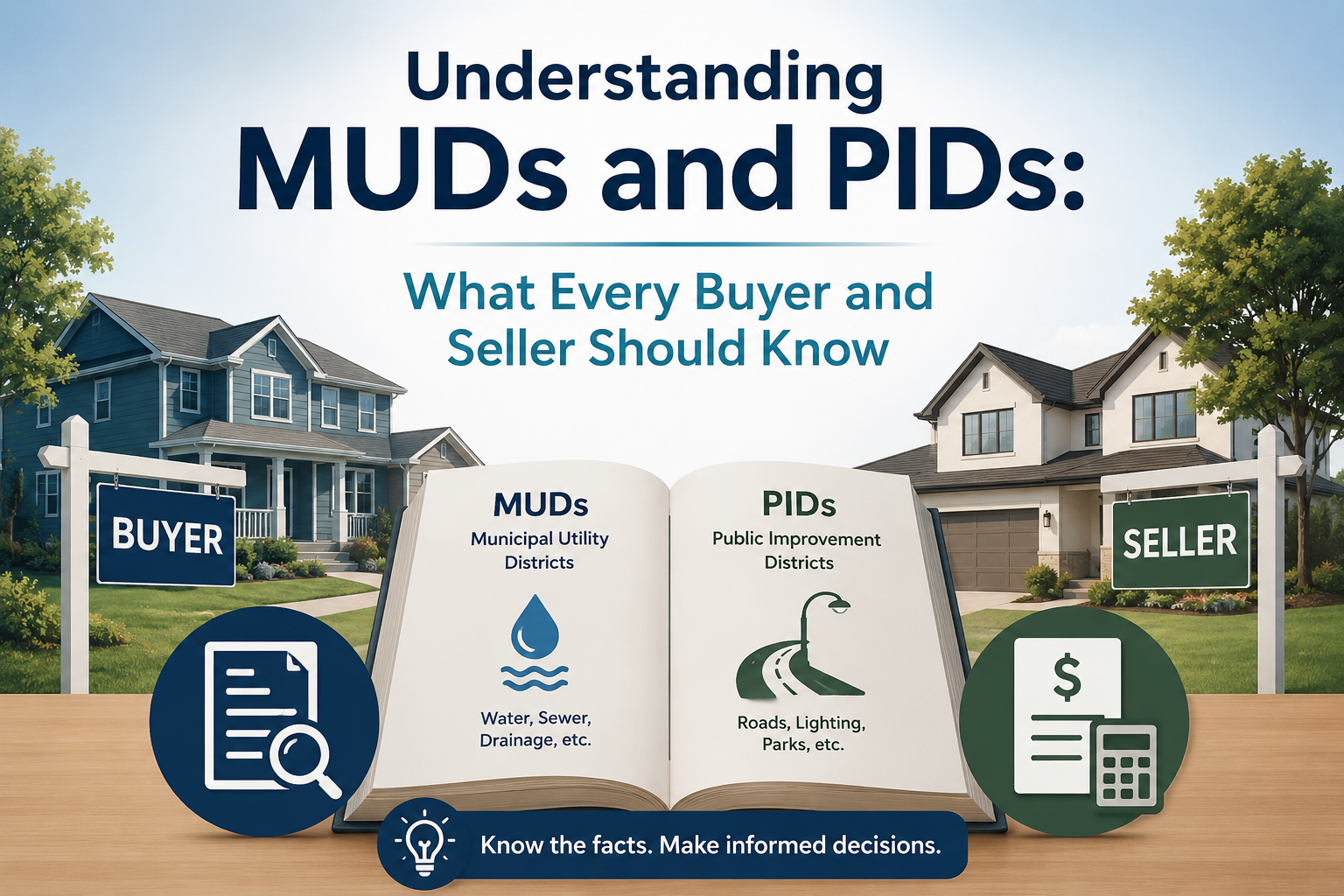
A Municipal Utility District (MUD) is a special political subdivision created to provide essential services to these new developments. We are talking about the absolute necessities of modern living: water, sewage, and drainage.
How a MUD Works
When a developer builds a neighborhood in a rural area, the nearest city will not pay to run water pipes and sewer lines all the way out to the new homes. The city taxpayers do not want to foot the bill for a neighborhood they do not live in.
Instead, the developer establishes a MUD. The MUD borrows money through municipal bonds to build the water towers, lay the sewer pipes, and create the drainage systems. Once people start buying homes in the neighborhood, the residents pay back that debt through a special property tax.
A Simple Example of a MUD
Imagine you buy a tent and want to camp in an empty field. You have no running water and no toilets. If you want to build a permanent house there, you need pipes.
Because the city refuses to pay for your pipes, you borrow money from a bank to install them yourself. You then pay a little bit every month to pay off that loan. A MUD does exactly this, just on a massive scale for an entire neighborhood. The tax you pay directly funds the clean water flowing from your kitchen sink and ensures your street does not flood when it rains.
What is a PID? (Public Improvement District for Buyers)
Now that we understand how basic utilities get funded, we need to look at the community enhancements. A Public Improvement District (PID) funds the "extras" that make a neighborhood highly desirable and visually appealing.
While a MUD focuses on basic survival necessities underground, a PID focuses on the visible amenities above ground. A city or county creates a PID to fund improvements that benefit a specific group of properties.
The Purpose of a PID
Developers use PIDs to build things that elevate the community lifestyle. This includes building expansive community pools, installing decorative streetlights, paving miles of landscaped walking trails, or creating heavily gated security entrances.
Unlike a MUD, which is a tax based on the changing assessed value of your home, a PID is a fixed assessment. When the developer builds the neighborhood, they calculate the total cost of the fancy amenities. They divide that total cost equally among the lots in the neighborhood.
A Simple Example of a PID
Imagine you and five neighbors share a large, empty backyard. You all decide you want to build a luxury swimming pool. The pool costs $60,000. You divide the cost evenly, meaning each neighbor owes $10,000.
You can either write a check for $10,000 upfront, or you can pay it off over twenty years with a small yearly payment. That is exactly how a PID operates. It pays for the fun, beautiful upgrades that make your neighborhood a great place to live.
MUD vs PID: The Key Differences Dummy-Proofed
People often confuse these two districts because both add an extra line item to your yearly housing costs. However, they operate very differently. Let us break down the core differences so you can easily spot them.
Needs vs. Wants
The easiest way to remember the difference is to think about needs versus wants.
-
MUD: Funds basic survival needs. It pays for the water pipes, sewer lines, and drainage ditches. You cannot live in a modern home without these things.
-
PID: Funds community wants. It pays for the splash pads, the beautiful stone retaining walls, and the manicured parks. You can live without them, but they make life much more enjoyable.
Payment Structure
-
MUD: Operates as a true property tax. The amount you pay fluctuates based on the assessed value of your home. If your home value doubles, your MUD tax bill will likely increase.
-
PID: Operates as a fixed assessment. A specific dollar amount is assigned to your lot. It does not matter if your home doubles in value; the total PID amount you owe remains the exact same.
The Lifespan of the District
-
MUD: The tax rate usually starts high when the neighborhood is brand new because the debt is huge. As more neighbors move in and pay into the system, the tax rate often drops. Eventually, a nearby city might annex the neighborhood, dissolve the MUD, and take over the utility maintenance.
-
PID: Because it is a fixed loan for a specific project, it has a definitive end date. Many homeowners actually choose to pay off their entire PID balance in one lump sum when they buy the house, eliminating the yearly payment entirely.
How These Districts Impact Rural Property Taxes
When people move out of major metropolitan areas, they often expect their property taxes to plummet. Looking at rural property taxes on paper can feel very exciting. The county tax rate might sit incredibly low compared to the city you just left.
However, rural property taxes alone do not tell the whole story. Because these rural areas lack existing infrastructure, almost every new master-planned community utilizes a MUD, a PID, or sometimes both.
When you add the county tax, the school district tax, and the MUD tax together, your total effective tax rate might look very similar to the city tax rate you tried to escape. Buyers must calculate the total combined tax rate before deciding a home is affordable. A house with a lower purchase price but a heavy MUD tax can actually cost you more every month than a slightly more expensive house with no MUD.
Why Buyers and Sellers Must Pay Attention
Understanding the ins and outs of a Municipal Utility District explained here, alongside a Public Improvement District for buyers, is not just trivial real estate trivia. It directly impacts your legal obligations and your daily budget.
Critical Information for Homebuyers
As a buyer, you must factor these districts into your monthly mortgage payment. When you use an online mortgage calculator, it usually only estimates standard city and county taxes. You must manually add the MUD or PID fees to determine your true monthly escrow payment.
Furthermore, you should ask your real estate agent to pull the history of the MUD tax rate. Is the neighborhood brand new with high initial taxes, or is it an established neighborhood where the MUD debt is almost entirely paid off? Knowing this timeline helps you predict your future financial obligations.
If the home has a PID, ask if the previous owner paid it off. If they did not, ask exactly how much of the assessment remains and when it officially expires.
Essential Rules for Home Sellers
If you are selling a home located in one of these districts, you carry a strict legal burden. In many states, including Texas, the law requires sellers to provide buyers with specific, formal disclosure notices regarding MUDs and PIDs before signing a contract.
Failing to provide these legal disclosures can destroy your sale. A buyer can legally walk away from the deal at the last minute and demand their earnest money back if you hide this information.
Instead of viewing these districts as a negative feature, smart sellers use them as marketing tools. You should highlight the incredible benefits these districts provide. Remind buyers that the MUD guarantees them reliable, high-quality water infrastructure in a rural setting. Show off the stunning community pool and pristine walking trails funded by the PID. When buyers understand exactly what their money pays for, they feel much more comfortable moving forward.
Conclusion: Navigate Your Real Estate Journey with Confidence
Hearing strange real estate acronyms does not have to cause panic. MUDs and PIDs simply represent the cost of bringing modern convenience and luxury living to newly developed areas. A MUD ensures your home functions safely with clean water and proper drainage, while a PID transforms a basic subdivision into a vibrant, beautiful community.
By understanding exactly how these districts impact your monthly budget and rural property taxes, you empower yourself to make brilliant financial decisions. You will never get caught off guard by a surprise tax bill, and you will know exactly how to market your home when it is time to sell.
If you are currently navigating the real estate market and feel unsure about the districts attached to a property, do not guess. Reach out to a knowledgeable local real estate professional. They can look up the exact tax rates, explain the remaining assessments, and help you secure a home that fits perfectly into your long-term financial plan.
Ready to Take the Next Step?
Whether you are buying, selling, or just exploring the market, I am here to help. Search homes for sale or contact me to talk through your goals. Call or text (214) 380-3525. Hablo español.
— Lisbeth Arias, REALTOR® | eXp Realty